
Hardest Chapters in Class 11 Chemistry: Study Tips That Work
- Updated on
 Ashique Muhammed
CBSE Class 11 Chemistry is the chapter where scores fall and confidence breaks , even for students who sailed through Class 10. The jump from surface-level memorisation to deep conceptual understanding catches most students off guard, and without the right guidance, even hardworking students find themselves stuck.
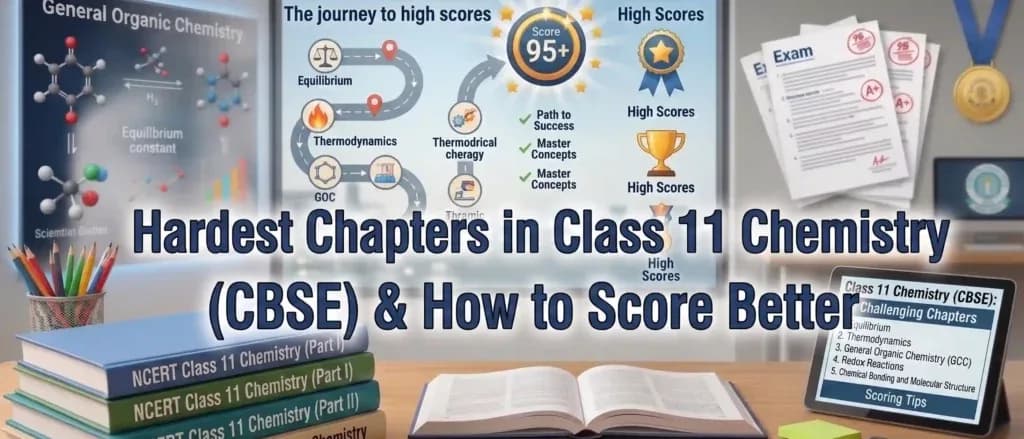
The hardest chapters in CBSE Class 11 Chemistry are Mole Concept, Structure of Atom, Thermodynamics, Chemical Bonding, and Organic Chemistry , Basic Principles. These five topics account for the majority of student dropoffs in marks and confidence during the first year of senior secondary school.
This guide is for parents of CBSE Class 11 students who are struggling , or are worried their child might struggle , with Chemistry this year. At Angle Tuition, we work with hundreds of Class 11 CBSE students every year through one-to-one personalised learning. What you'll find here is a clear breakdown of which chapters trip students up the most, exactly why they're difficult, and the targeted strategies our teachers use to help students recover their scores.
- Why Does Class 11 Chemistry Feel So Much Harder Than Class 10?
- Which Are the Hardest Chapters in CBSE Class 11 Chemistry?
- Chapter Difficulty Comparison: What Our Teachers Have Found
- What Common Mistakes Do Class 11 Students Make in Chemistry?
- What Does a Smart Study Plan for Class 11 Chemistry Look Like?
- How Can Your Child Score Better in Class 11 Chemistry?
Why Does Class 11 Chemistry Feel So Much Harder Than Class 10?
Class 10 Chemistry relies heavily on definitions, simple reactions, and a basic understanding of atoms and molecules. Class 11 Chemistry is a completely different subject. It demands that students build and apply conceptual frameworks , understanding why reactions happen, not just what they produce.
Here is what changes in Class 11 Chemistry:
- From memory to application: Topics like stoichiometry, enthalpy, and quantum mechanical models require working knowledge , not rote learning.
- Numerical problems increase: Mole concept, thermodynamics, and equilibrium bring heavy numerical work , unit conversions, formula application, and multi-step calculations.
- Abstract concepts appear for the first time: Quantum numbers, hybridisation, VSEPR theory, and reaction mechanisms are entirely new territory.
- Organic Chemistry starts: A completely new branch of chemistry with its own logic, nomenclature, and reaction mechanisms arrives in Class 11.
- NCERT depth increases sharply: The NCERT textbooks for Class 11 are significantly denser and more demanding than Class 10.
In our experience at Angle Tuition, students who score above 85% in Class 10 Science often find themselves scoring below 60% in their first Class 11 Chemistry test , not because they are less capable, but because the approach to studying has not yet shifted. This is a critical window where personalised academic support makes a measurable difference.
Which Are the Hardest Chapters in CBSE Class 11 Chemistry?
- The concept of Avogadro's number (6.022 × 10²³) feels abstract , students cannot visualise it
- Interconversions between moles, mass, volume, and number of particles cause frequent errors
- Stoichiometric calculations , especially limiting reagent problems , require multi-step reasoning
- Percentage composition and empirical formula problems combine maths and chemistry in ways students aren't prepared for
Based on patterns we see across our CBSE Class 11 students , and verified by NCERT exam performance data , here are the five chapters where students struggle the most, along with targeted strategies that actually help.
Some Basic Concepts of Chemistry , The Mole Concept
This is Chapter 1 of NCERT Class 11 Chemistry , and it already derails many students in the first month. The mole concept sits at the foundation of all quantitative chemistry, making it one of the most consequential chapters of the entire year.
- Build a simple conversion chart: moles ↔ grams ↔ litres (at STP) ↔ particles. Stick it above your study desk.
- Solve at least five mole concept numericals every day for the first two weeks
- Write out each step of the calculation , never skip steps to save time
- Master all NCERT in-chapter examples before attempting exercise problems
- The four quantum numbers (n, l, m, s) and their allowed values are confusing to memorise in isolation
- Orbital shapes (s, p, d, f) are abstract , most students cannot visualise 3D electron probability distributions
- Aufbau principle, Hund's rule, and Pauli's exclusion principle must all be applied together for electron configuration
- Exception configurations (like Cr and Cu) trip up even prepared students
Structure of Atom , Quantum Numbers and Electron Configuration
The Structure of Atom chapter in CBSE Class 11 Chemistry introduces students to quantum mechanics , a world that exists beyond ordinary human experience. Bohrs model gives way to wave-mechanical models, and many students lose their footing here.
- Learn quantum numbers through their physical meaning , not just their values , n = energy level, l = subshell shape, m = orientation, s = spin
- Draw orbital diagrams by hand for at least 20 elements , the muscle memory helps
- Use the diagonal rule (Moeller diagram) as a visual anchor for Aufbau filling order
- Revise this chapter every two weeks , concepts fade quickly without repetition
- Sign conventions for heat (q), work (w), and internal energy (ΔU) cause consistent errors
- Hess's Law problems involve multi-step calculations where one wrong sign ruins the entire answer
- The concept of entropy , disorder at the molecular level , is counterintuitive for most students
- Students often try to memorise Gibbs equations without understanding what spontaneity means physically
Thermodynamics , Enthalpy, Entropy, and Gibbs Energy
Thermodynamics in Class 11 Chemistry is the chapter that separates students who understand physics from those who don't. The concepts of enthalpy change (ΔH), entropy (ΔS), Gibbs free energy (ΔG), and spontaneity require both conceptual clarity and numerical fluency , simultaneously.
- Build a sign convention reference table first , before touching any numerical
- Understand the physical story: exothermic means energy released to surroundings (ΔH negative)
- Practice Hess's Law with at least 10 varied problems , the pattern becomes clear after enough repetition
- For Gibbs energy: memorise the four combinations of ΔH and ΔS and what each means for spontaneity
- Multiple overlapping concepts , Lewis structures, formal charge, resonance , are often confused with each other
- VSEPR geometry requires spatial reasoning , many students cannot visualise 3D molecular shapes from 2D diagrams
- Hybridisation (sp, sp², sp³, sp³d, sp³d²) is memorised without understanding how bond angles connect to geometry
- Molecular orbital theory (bonding vs antibonding orbitals, bond order) adds another layer students rarely master
Chemical Bonding and Molecular Structure , VSEPR, Hybridisation, and Molecular Shapes
Chemical Bonding is one of the most marks-rich chapters in CBSE Class 11 Chemistry , and also one of the most frequently under-prepared. The combination of ionic bonding, covalent bonding, VSEPR theory, hybridisation, and molecular orbital theory creates a workload that overwhelms students who don't organise their preparation.
- Study this chapter in clear sub-topics: Lewis structures → VSEPR → Hybridisation → Polarity → MO Theory
- Draw every molecular shape by hand , use 3D model kits if available, or clay models at home
- Create a table with molecule name, Lewis structure, VSEPR shape, hybridisation, and bond angles for 20 common molecules
- Focus the majority of time on VSEPR and hybridisation , these are most frequently tested in boards
- IUPAC nomenclature has strict rules , one mistake in naming creates a completely wrong answer
- Electronic effects (inductive, resonance, hyperconjugation) are abstract and require understanding electron movement
- Reaction mechanisms , electrophiles, nucleophiles, carbocations, carbanions , require a new way of thinking about bonds
- Students try to memorise reactions instead of understanding the pattern , this fails badly in exams
Organic Chemistry , Basic Principles and Techniques
For most CBSE students, Organic Chemistry begins in Class 11 , and it feels like learning a new language. IUPAC nomenclature, functional groups, inductive effects, resonance, and reaction mechanisms are all entirely new. Students who fall behind here struggle through Class 12 as well, since organic chemistry builds directly on these foundations.
- Learn all functional groups with their IUPAC suffixes and prefixes before attempting any reactions
- Practice IUPAC naming daily , 10 structures per day for two weeks builds strong pattern recognition
- Understand electronic effects through analogy: electrons move toward electron-withdrawing groups the way water flows downhill
- For reactions: always ask "why does this happen?" before "what happens?" , mechanism comes before memorisation
Chapter Difficulty Comparison: What Our Teachers Have Found
Based on assessment data and teacher observations across our CBSE Class 11 Chemistry students at Angle Tuition, here is how the five hardest chapters compare on key difficulty indicators:
Chapter Difficulty Comparison: What Our Teachers Have Found
| Chapter | Primary Difficulty | Numerical Load | Marks Weightage | Recovery Time Needed |
|---|---|---|---|---|
| Mole Concept | Calculation errors, unit confusion | Very High | 7,9 marks | 2,3 weeks |
| Structure of Atom | Abstract concepts, quantum models | Medium | 6,8 marks | 2 weeks |
| Thermodynamics | Sign convention, Hess's Law | High | 8,10 marks | 3 weeks |
| Chemical Bonding | Visualisation, multiple sub-topics | Low,Medium | 9,11 marks | 3,4 weeks |
| Organic Chemistry Basics | New language, mechanism thinking | Low | 8,10 marks | 4 weeks |
* Marks weightage is approximate based on CBSE board exam patterns from 2022,2025. Actual distribution may vary.
What Common Mistakes Do Class 11 Students Make in Chemistry?
When we assess a new Class 11 Chemistry student at Angle Tuition, we see the same patterns repeatedly. Identifying and fixing these errors early is the fastest way to recover marks:
- Memorising without understanding: Students write formulas without knowing what variables represent. When exam questions change the format slightly, the student cannot adapt.
- Ignoring NCERT in-chapter examples: Many students skip straight to exercise problems. The NCERT examples are specifically designed to build problem-solving logic , skipping them creates large gaps.
- Not practising numericals daily: Mole concept and thermodynamics require daily practice. Students who study theory one day and solve problems the next lose continuity and make careless errors.
- Skipping revision cycles: Chemistry concepts , especially structure of atom and chemical bonding , fade within two weeks if not revised. Students who study a chapter once and move on find it gone by exam time.
- Treating organic chemistry like inorganic: Students try to memorise organic reactions as isolated facts rather than understanding the underlying electronic logic. This breaks down completely in exams.
- Avoiding drawing: Chemical bonding and organic chemistry both require drawing , Lewis structures, orbital diagrams, structural formulas. Students who only write text-based answers lose marks on questions that require diagrams.
What Does a Smart Study Plan for Class 11 Chemistry Look Like?
- First 20 minutes: Quick revision of the previous day's work , read your short notes, not the full chapter
- Next 40 minutes: Learn new concept from NCERT , read once, close the book, write what you remember
- Next 30 minutes: Solve 3,5 NCERT examples and exercise problems from the new topic
- Final 10 minutes: Write short notes , key formulas, exceptions, and one worked example per topic
- Every Saturday: Revise the entire week's topics using your short notes , this takes only 30,40 minutes
- Every two weeks: Solve a full mixed-topic test covering all chapters studied so far , timed, exam-style
- Monthly: Review all error patterns from tests , identify whether mistakes are conceptual (need re-study) or careless (need more practice)
A high-scoring study plan for CBSE Class 11 Chemistry is built on three principles: concept first, numericals daily, revision weekly. Here is a practical structure that works for most students:
Daily Study Routine (1.5 to 2 Hours)
Weekly Revision Strategy
How Can Your Child Score Better in Class 11 Chemistry?
These are the highest-impact actions that consistently improve scores in CBSE Class 11 Chemistry:
- Make NCERT non-negotiable: Every CBSE Class 11 Chemistry board question is either directly from NCERT or based on NCERT concepts. Students who master the NCERT textbook , examples, exercises, and exemplar problems , have a strong base.
- Prioritise weak chapters first: Start your preparation with the chapter where your score is lowest. Most students do the opposite , they practice what they already know. Fixing weak chapters gives the highest marks gain.
- Build a formula sheet by hand: Writing formulas, reaction conditions, and exceptions by hand aids memory significantly more than reading or highlighting.
- Solve previous year CBSE papers: CBSE Class 11 Chemistry has predictable question patterns. Solving 3,5 previous year papers from 2020,2025 reveals exactly which sub-topics are most tested.
- Get concept gaps addressed immediately: Every unresolved doubt compounds. A concept misunderstood in mole concept affects stoichiometry; a gap in bonding affects organic chemistry. When your child has a doubt, it needs to be resolved the same day , not left for the next class.
If your child's school class moves at a pace that doesn't allow doubt resolution, or if the teacher-to-student ratio means your child rarely gets individual attention, a personalised one-to-one learning plan can bridge that gap significantly. [INTERNAL LINK: CBSE Class 11 Chemistry tuition]
Frequently Asked Questions (FAQs)
Your Child Can Turn Class 11 Chemistry Around , Here Is Where to Start
- What Are The Basic Math Skills Every Child Should Learn?
- How to Fix Weak Maths Basics Before CBSE Class 9 Starts
- Why Is The Pythagorean Theorem Important In Math And…
- How To Help Your Child Learn Math At Home?
Class 11 Chemistry does not have to be the chapter that breaks your child's confidence. With the right structure, targeted chapter focus, and consistent daily practice, students can recover quickly and build a strong foundation for Class 12 and beyond. Bookmark this page, share it with your child, and revisit the study strategies each time a difficult chapter comes up.
More Helpful Guides
Request a free Demo
Latest Blogs
- CBSE Class 12 Chapter Wise Weightage 2026 | Angle Tuition
- CBSE Class 12 Re-evaluation Results 2026 | Angle Tuition

- CBSE 3 Language Policy 2026 , R1, R2 and R3 Explained

- New NCERT Science Book Class 9 (2026, 27): Updated Chapters & Changes Explained

- CBSE Class 10 Chapter-Wise Weightage 2026, From Where Do Most Questions Come?

- CBSE Competency Focused Practice Questions: Free PDFs

- Best Books for CBSE Class 10 CBQ Practice 2026: Oswaal vs Educart vs Arihant

- How to Solve Case Study Questions CBSE: 7-Step Strategy
- How to Solve CBSE Competency-Based Questions (2026): The Complete Strategy Guide for Class 10 Science & Maths
- Step-by-Step Guide to Submit CBSE Private Exam Form 2026