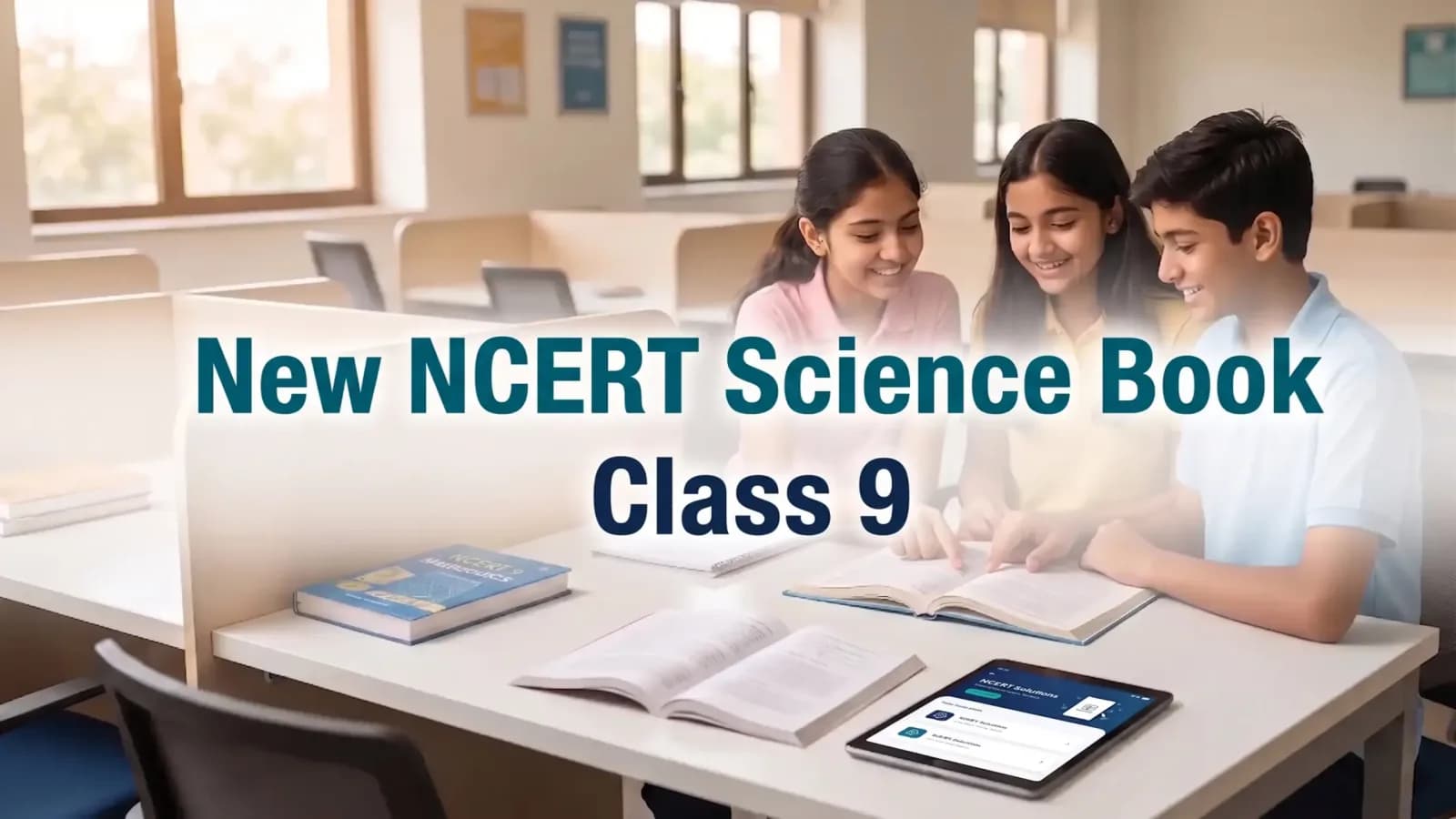
New NCERT Science Book Class 9 (2026, 27): Updated Chapters & Changes Explained
- Updated on
 Ashique Muhammed
NCERT has released a fully redesigned Class 9 Science textbook for the 2026, 27 academic session. Aligned with the National Education Policy (NEP) 2020 and the National Curriculum Framework for School Education (NCF-SE) 2023, the new book now has 12 chapters, integrating Physics, Chemistry, Biology, and Earth Science under one cover. The focus has shifted from memorisation to conceptual understanding, hands-on experiments, and real-life application of scientific ideas.
This is the most significant Science curriculum overhaul in over two decades for CBSE students. If your child is entering Class 9 in 2026, 27, this guide tells you exactly what is new, what has changed, and how to prepare.
Chapter-by-Chapter Breakdown of the New Book
The new NCERT Class 9 Science Exploration textbook has 13 chapters. Click any chapter title to access the official NCERT PDF.
| Chapter | What Your Child Will Learn |
|---|---|
| Chapter 1 Exploration: Entering the World of Secondary Science | Introduces scientific thinking, inquiry-based learning, observation skills, and how secondary science connects to real-world problems and everyday life. |
| Chapter 2 Cell: The Building Block of Life | Explores plant and animal cells, key organelles, prokaryotic and eukaryotic differences, cell membrane permeability, and recent advances in cell biology. |
| Chapter 3 Tissues in Action | Covers plant and animal tissue types, meristematic and permanent tissues, and the musculoskeletal system, posture, injuries, and exercise. |
| Chapter 4 Describing Motion Around Us | Teaches displacement, velocity, acceleration, graphical representation of motion, kinematic equations, and an introduction to uniform circular motion. |
| Chapter 5 Exploring Mixtures and Their Separation | Covers solutions, colloids, suspensions, concentration expressions, and separation techniques like distillation, chromatography, centrifugation, and crystallisation. |
| Chapter 6 How Forces Affect Motion | Explains balanced and unbalanced forces, friction, Newton’s three laws of motion, inertia, momentum, and their real-world applications. |
| Chapter 7 Work, Energy, and Simple Machines | Covers work, kinetic and potential energy, conservation of energy, power, and simple machines, levers, pulleys, and inclined planes with mechanical advantage. |
| Chapter 8 Journey Inside the Atom | Studies subatomic particles, Thomson’s, Rutherford’s, and Bohr’s atomic models, electron distribution, valency, isotopes, and isobars. |
| Chapter 9 Atomic Foundations of Matter | Explains Dalton’s theory, laws of conservation of mass and constant proportion, chemical formulae writing, molecular mass, and ionic compounds. |
| Chapter 10 Sound Waves: Characteristics and Applications | Covers production and propagation of sound, frequency, amplitude, pitch, loudness, echo, reverberation, and real-world echolocation applications. |
| Chapter 11 Reproduction: How Life Continues | Covers asexual and sexual reproduction, pollination, fertilisation, human reproductive systems, menstrual cycle, reproductive health, and birth control basics. |
| Chapter 12 Patterns in Life: Diversity and Classification | Introduces the five kingdoms, major animal and plant divisions, binomial nomenclature, and acellular entities including viruses. |
| Chapter 13 Earth as a System: Energy, Matter, and Life | Covers solar radiation, differential heating, biogeochemical cycles, water, carbon, nitrogen, oxygen, and human impact on Earth’s interconnected systems. |
What Has Changed from the Old Science Textbook
Content and Chapter Structure
The old Science textbook had 15 chapters spread across separate Physics, Chemistry, and Biology sections. The new textbook brings this down to 12 well-structured chapters that are interconnected by theme. Topics have been reorganised based on developmental readiness, for example, Reproduction (previously a Class 10 topic) now appears in Class 9. The Gravitation chapter has been removed from Class 9 entirely and may appear in a different form in Class 10.
Work and Energy has been expanded to include Simple Machines, levers, pulleys, and inclined planes, giving students practical engineering context alongside core Physics concepts.
Approach to Learning
The old book was built on theory-first learning. Students were expected to read definitions, memorise answers, and reproduce them in exams. The new book flips this model. Each chapter now begins with observation and inquiry, asking students to notice, question, and connect before they receive an explanation. This is called inquiry-based learning, and it is central to the NCF-SE 2023 framework.
Practical and Activity-Based Learning
Every chapter now includes dedicated activity sections. Students are expected to prepare slides, carry out osmosis experiments, design low-cost cell models, observe sound waves, and apply force concepts in real settings. Science is no longer just read, it is done. This means lab sessions and home activities become a regular part of your child’s Science learning, not just an occasional school exercise.
Question Pattern and Assessment
Expect far fewer “define this” or “list the types of” questions. The new assessment style focuses on application, reasoning, and case-based problems. Students will be asked to explain why something happens, apply a concept to a new situation, or analyse a real-world case study. School-level internal assessments may also allow open-book formats, focusing on thinking, not memorisation.
Advantages of the New Approach for Your Child
The redesign is not just a change in chapters, it is a change in how Science is experienced as a subject. Here is what your child stands to gain:
- Stronger conceptual clarity, fewer topics covered with much greater depth means ideas actually stick
- Reduced rote memorisation, students learn to reason and apply, not just recall
- Better foundation for Class 10, JEE, and NEET, spiral learning means advanced ideas arrive earlier, giving more time to master them
- Greater curiosity and engagement, activity-based chapters make Science something students want to explore, not just pass
- Real-world relevance, chapters on Earth systems, reproductive health, and musculoskeletal care connect Science to daily life
Challenges to Watch Out For
Being honest with you: this transition will not be without friction. Here are the real challenges your child may face:
- Adjustment period, students used to theory-first learning may find the inquiry-based approach unfamiliar at first
- Application questions feel harder initially, when exams shift to reasoning and case-based formats, students who relied on memorisation will struggle
- Teacher readiness varies by school, not all teachers will have been trained yet on the new pedagogy; some classrooms may still teach the old way
- Old study guides and reference books are outdated, standard guides based on the old syllabus will have wrong chapters and incorrect exam patterns
- Practical sessions need resources, activity-based learning requires access to lab equipment or home materials that not every school provides equally
What Parents and Students Should Do Now
The transition is happening now. Students who prepare ahead will find the new curriculum far more manageable. Here is a clear action plan:
- Download the new textbook PDFs, Visit ncert.nic.in and download all 12 chapters for free before the session begins. Do not buy or use old Science guides.
- Read through chapter summaries first, Before diving in, get an overview of all 12 chapters. This gives your child context for how topics connect across Biology, Chemistry, and Physics.
- Focus on understanding, not memorisation, Encourage your child to ask “why does this happen?” at every step. The new exam pattern rewards explanation, not just recall.
- Take the activities seriously, Every practical activity in the new book is designed to reinforce a concept. Help your child set up simple home experiments where possible.
- Verify your school’s adoption timeline, Some schools may take a session to fully transition. Ask your child’s Science teacher which chapters will be assessed in the 2026, 27 exams.
- Get targeted support early, Chapters like Reproduction (moved from Class 10), Earth as a System, and Work + Simple Machines are new territory. One-to-one support helps your child build confidence before the concepts pile up.
How Angle Tuition Supports Your Child Through This Transition
When the new NCERT Science syllabus rolled out, one of our students, a Class 9 girl from a CBSE school in Kerala, came to Angle Tuition midway through Term 1. Her school had moved to the new book, but her tuition centre was still teaching from the old one. She had missed Reproduction entirely and was struggling with the Earth as a System chapter because no one had connected it to her Biology learning. In four weeks of 1-to-1 online sessions, she caught up on both chapters, built a solid understanding of biogeochemical cycles, and cleared her school unit test with 88%.
At Angle Belearn, every session is fully aligned with the new NCERT 2026, 27 Science curriculum. Our tutors match pace to each student’s understanding, not a fixed class schedule, and design the learning path around their specific gaps. If your child needs targeted support for the new chapters, visit anglebelearn.com to book a free 1-to-1 demo session.
Frequently Asked Questions (FAQs)
Conclusion
The new NCERT Class 9 Science textbook is a genuine step forward, it asks students to think, not just remember. The transition may feel unfamiliar at first, but with the right support and a clear understanding of what has changed, your child can adapt quickly and build a strong foundation for Class 10 and beyond. Bookmark this page and check back as schools confirm their adoption timelines and exam patterns are updated.
More Helpful Guides
- CBSE Class 10 Chapter-Wise Weightage 2026, From Where Do Most Questions Come?
- How to Solve CBSE Competency-Based Questions (2026): The Complete Strategy Guide for Class 10 Science & Maths
- CBSE Class 10 Science Paper Pattern 2026: Section-wise Marks, CBQs and Real Exam Insights
- CBSE Class 10 Additional Subject Rules 2026: Can It Save You If You Fail?
Request a free Demo
Latest Blogs
- CBSE 3 Language Policy 2026 , R1, R2 and R3 Explained
- NCERT New Book Class 9 Maths (2026,27) Ganita Manjari
- CBSE Class 10 Chapter-Wise Weightage 2026, From Where Do Most Questions Come?
- CBSE Class 10 Minimum Passing Marks 2026 , Out of 80, Out of 100
- Best Books for CBSE Class 10 CBQ Practice 2026: Oswaal vs Educart vs Arihant
- CBSE Class 10 Science Paper Pattern 2026: Section-wise Marks, CBQs and Real Exam Insights
- CBSE Class 10 Maths Paper Pattern 2026 | Sections A,E
- How to Solve Case Study Questions CBSE: 7-Step Strategy
- Best CBSE Schools in Kerala
- Top 3 NEET Coaching Centres in Kerala